

on November 22, 2025

The Complete Supplement Guide for HYROX Athletes in 2026: Evidence-Based Stacks for Every Level
For HYROX competitors at every level — first-race through Pro — who want a supplement strategy built from physiology first, not marketing first.
Table of Contents
- Direct Answer
- The HYROX Stack — Quick Reference
- TL;DR
- The Four Physiological Systems HYROX Taxes
- Tier 1: Non-Negotiable Foundation Supplements
- Tier 2: Performance Add-Ons with Clear Use Cases
- Tier 3: Recovery and Durability Support
- Stack by Competitive Level
- Race-Day Timing Protocol
- Training Phase Periodization
- Product Quality Standards
- What to Skip
- FAQ
- References
HYROX has a useful quirk: the race format never changes. Eight one-kilometer runs alternating with eight fixed functional stations, at every venue, every time. That means you can plan your supplement strategy around exactly what your body is going to face — which stations will drain you, which energy systems get taxed hardest, and what you can do in advance to make sure you have more left when it counts. This guide covers the supplements that actually move the needle for HYROX, what each one does, the doses the research supports, and how to stack them by competitive level. For the complete training framework that sits underneath this supplement strategy, see the hybrid training complete guide.
Direct Answer
The four supplements every HYROX athlete should be taking are creatine monohydrate, caffeine, beta-alanine, and sodium-forward electrolytes. Creatine gives your muscles more stored energy for the explosive stations — start 4+ weeks out at 5 g/day. Caffeine is the single highest-return thing you can take on race morning — 3–5 mg/kg, 45–75 minutes before you start. Beta-alanine stops your muscles from burning out as fast on the grinding stations, but only works if you've been taking it daily for 4–6 weeks beforehand. Sodium electrolytes before the race — not just water — is the move most athletes aren't making. Everything else in this guide builds on top of these four.
The HYROX Stack — Quick Reference
Already know what you need? These are the three Fathom Nutrition products that cover the full HYROX foundation. Full detail, evidence, and competitive-level guidance throughout the guide below.
Fathom Nutrition — The HYROX Foundation Stack — Full Ingredient Disclosure

Creatine Monohydrate
More stored muscle energy at every station. Faster recovery between efforts. 5 g/day, one ingredient.
Shop Creatine →

Pre Workout
Clinical caffeine + 6 g citrulline + 3.2 g beta-alanine + L-tyrosine + electrolytes. Every dose disclosed.
Shop Pre Workout →

Hydration
350 mg sodium for pre-race plasma volume. KSM-66 600 mg. Tart Cherry. Magnesium bisglycinate.
Shop Hydration →
TL;DR
HYROX hits four things hard: your explosive power at the heavy stations, your ability to sustain effort on the grinding stations, your running legs across all eight 1 km segments, and your hydration through the back half of the race. Creatine is the most important supplement you can take — it directly affects how much power you have at every station and how fast you recover between them. Beta-alanine helps your muscles resist the burning sensation that forces you to slow down on the SkiErg, RowErg, and wall balls, but only if you've been loading it for 4–6 weeks before race day. Drinking enough sodium before the race — not just water — is the one thing most HYROX athletes are skipping. BCAAs are a waste of money for anyone eating enough protein. If you're competing at Pro level, stick to NSF 455 or NSF Certified for Sport products — drug testing protocols apply.
The Four Physiological Systems HYROX Taxes
Every supplement in a well-designed HYROX stack targets one of four physiological systems. Understanding which system each station stresses is what explains why specific supplements produce the effects they do.
01
Sled Push & Pull
Explosive Power
→ Creatine
02
Burpee Broad Jump
Explosive Power
→ Creatine
03
SkiErg & RowErg
Muscle Endurance
→ Beta-Alanine
04
Sandbag Lunge & Wall Ball
Muscle Endurance
→ Beta-Alanine
05
Farmer's Carry
Aerobic + Grip
→ Caffeine + Citrulline
06
8 × 1 km Runs
Running Capacity
→ Caffeine + Nitrate
07
Full Race Duration
Hydration
→ Sodium Electrolytes
08
Transitions + Late Race
Mental Sharpness
→ Caffeine + L-Tyrosine
| System | Where you feel it in the race | What helps |
|---|---|---|
| Explosive power | Sled push, sled pull, burpee broad jump — short maximal efforts. Gets worse in the second half as stored muscle energy depletes. | Creatine monohydrate (5 g/day, start 4+ weeks out) |
| Muscle burning endurance | SkiErg, RowErg, sandbag lunge, wall balls — 2–6 min grinding efforts where your muscles start burning and force you to slow down. | Beta-alanine (4–6 weeks daily loading); sodium bicarbonate (advanced athletes only) |
| Running capacity | All 8 × 1 km runs. Holding your pace on runs 6, 7, and 8 when your legs are already cooked from the stations. | Caffeine; dietary nitrate (beet root); your aerobic base |
| Staying strong late in the race | The full race, but especially the second half. As you sweat sodium out, your heart works progressively harder — which is why the last 20 minutes feel disproportionately hard. | Sodium electrolytes before, during, and after |
Tier 1: Non-Negotiable Foundation Supplements
Get these four right before spending money on anything else. Each one directly addresses a real limiter in HYROX. Missing any of them on race day means the rest of your stack is working against an incomplete foundation.
1. Creatine Monohydrate
Daily Dose 5 g/day
Timing Any time, consistently
Start 4+ weeks before race
Effect ~20% more stored muscle energy
Certification NSF 455
Creatine is the highest-priority supplement for HYROX, and it's not close. Your muscles store a fast-access fuel called phosphocreatine that powers the first few seconds of any explosive effort — the sled push, the burpee broad jump, anything requiring a hard burst. The more you have stored, the more power you produce and the faster you recover between efforts. Supplementing at 5 g/day increases those stores by about 20% — meaning more in the tank at station 3, and crucially, more left by station 6. The ISSN Position Stand rates this as Level A evidence across hundreds of trials — the strongest evidence category in sports nutrition. It takes 3–4 weeks of daily use to fully saturate your muscles, so start well before your target race. If you're within 2 weeks of race day, you can accelerate with 20 g/day in four doses for 5–7 days. For the complete evidence review see the ultimate creatine guide and the creatine dosage guide for hybrid athletes.
What we built for this
One ingredient should mean one thing: creatine, at the right dose, with nothing added. Fathom Creatine is 5 g of 200-mesh micronized creatine monohydrate per serving — no fillers, no sweeteners, no proprietary blend. NSF 455 certified on every production batch, which means independently tested for banned substances and label accuracy before it ships.
Fathom Nutrition
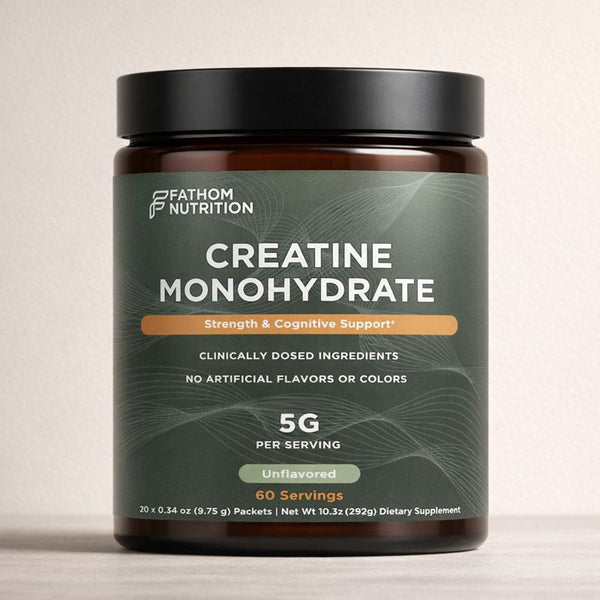
Creatine Monohydrate
More stored muscle energy at every station. Better power output at the sled. Faster recovery between efforts so the back half doesn't fall apart. 5 g, one ingredient. NSF 455 certified on every production batch. No fillers. No proprietary blends. Nothing artificial.
Training block tip: Creatine needs 4+ weeks daily to saturate — and must be maintained daily to stay saturated. Subscribe and save 15% so you never run out mid-block.
2. Caffeine
Race Dose 3–5 mg/kg body weight
Timing 45–75 min before race start
70 kg athlete 210–350 mg
Performance gain 2–7% (meta-analysis)
Caffeine makes hard efforts feel less hard — that's the short version. It blocks adenosine receptors in your brain that signal fatigue, which means the same pace feels easier and you can sustain higher output for longer. Across a 70-minute HYROX race, the research-supported improvement of 2–7% translates to 1–5 minutes of race time. One critical thing most athletes don't act on: if you drink coffee every day, your body adapts and the race-day effect is weaker. Cutting back significantly for 7–10 days before a target race resets this — and the first full dose after a break hits noticeably harder. Fathom Pre Workout contains natural caffeine at the clinical dose — see Pre Workout below.
3. Beta-Alanine
Daily Dose 3.2–6.4 g/day
Loading Time 4–6 weeks minimum
Best for 1–4 min grinding efforts
Mechanism Builds muscle carnosine buffer
You know the burning sensation that forces you to slow down on the sandbag lunge or wall balls? That's your muscles becoming more acidic — hydrogen ions build up faster than your body clears them, and your muscle fibers start failing. Beta-alanine works by increasing your muscles' buffer capacity — specifically a compound called carnosine that soaks up those hydrogen ions and keeps you firing longer before the burn sets in. The catch: it takes 4–6 weeks of daily use to build up enough carnosine to matter. Starting the week before a race gets you the harmless tingling side effect and zero performance benefit. Start it at the beginning of your training block. Divide your daily dose across 2–3 servings to reduce tingling without affecting how well it works. Meta-analytic evidence.
4. Sodium-Forward Electrolytes
Pre-Race Sodium 400–600 mg
Timing 60–90 min before race start
Fluid Volume 400–600 ml
Sweat Sodium Loss 400–1,000 mg/L
Certification NSF 455
Most HYROX athletes hydrate before their race. Very few hydrate correctly. When you only drink water, you dilute the sodium in your blood — and sodium is what tells your body to hold onto fluid. Without it, you can drink plenty and still be dehydrated where it counts. By the time you're hitting station 5 or 6, your heart is working harder, your muscles are tighter, and everything feels worse — not because you didn't drink enough, but because what you drank didn't have enough sodium. Taking 400–600 mg of sodium in a full glass of water 60–90 minutes before you race gives your cardiovascular system a buffer that most competitors won't have. Post-race, the same principle applies — a sodium drink restores hydration significantly faster than plain water. This is the most underused performance strategy in HYROX. For the complete sodium and electrolyte evidence base, see the electrolyte guide for endurance athletes.
What we built for this
Fathom Hydration has 350 mg sodium per serving from sodium citrate and sea salt — enough to drive real fluid retention when you take it 60–90 minutes before race start. It also has KSM-66 ashwagandha at 600 mg for managing the stress hormone buildup across heavy training blocks, tart cherry for soreness recovery between sim days, and magnesium bisglycinate for sleep quality and overnight recovery. NSF 455 certified on every batch.
Fathom Nutrition
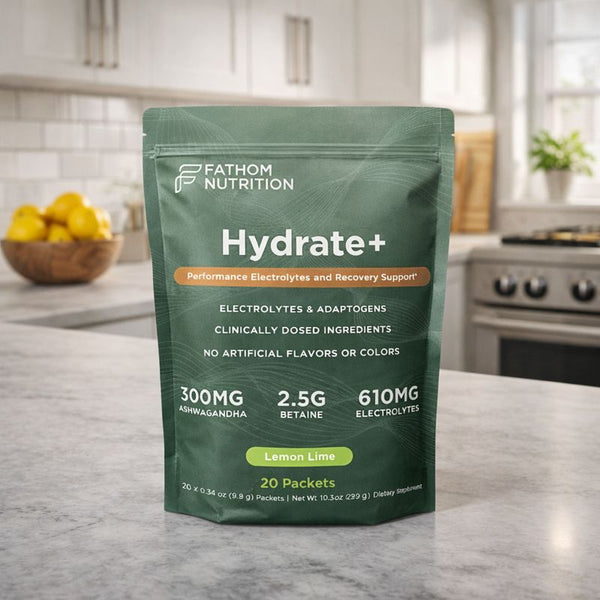
Hydration
350 mg sodium to keep your blood volume up through the back half of the race. KSM-66 Ashwagandha at 600 mg — the clinically studied form, at the clinical dose — for managing stress hormones across a hard training block. Tart Cherry Extract so you're not still sore from your last sim day. Magnesium bisglycinate for sleep quality and overnight recovery. Pre-race, post-race, and daily. NSF 455 certified. Nothing artificial. No proprietary blends.
Use it daily, not just race day: KSM-66 and magnesium bisglycinate build up over 4–8 weeks of consistent use. Subscribe and save 15% to cover the full training block.
Tier 2: Performance Add-Ons with Clear Use Cases
Three additional ingredients have strong enough evidence and specific enough HYROX relevance for serious competitors. Each has a defined use case. None of them are worth investing in until all four Tier 1 supplements are consistently in place.
5. Dietary Nitrate (Beet Root)
Dose 5–8 mmol nitrate
Timing 2–3 hrs pre-race
Loading 3–5 days race week
Best for Competitive and Pro athletes
Beet root makes your muscles use oxygen more efficiently — the same running pace costs less energy. That translates directly to holding your run pace later in the race when your legs are already cooked from the stations. The evidence is strongest for athletes in the 65–90 minute race duration range, which covers most HYROX Open and Sport competitors. One important practical note: don't use antibacterial mouthwash for 4–6 hours around taking it — the nitrate needs bacteria in your mouth to convert into its active form, and mouthwash kills them.
6. Intra-Race Carbohydrates
Dose 20–30 g every 2–3 stations
When Race time >75 min only
If you're finishing under 75 minutes, your body probably has enough stored glucose to get through without topping up. Above that threshold — particularly in the sandbag lunge and wall balls in the final third — blood sugar drops and your muscles struggle to maintain output. A gel or chew every few stations prevents this. Start early (station 2 or 3) rather than waiting until you feel the need. Practice every intra-race fueling strategy in simulation training — never on race day for the first time.
7. Citrulline Malate
Dose 6–8 g
Timing 45–60 min before session or race
Effect Better blood flow, less fatigue buildup
Citrulline helps your body produce more nitric oxide, which relaxes blood vessels and improves blood flow to working muscles — most relevant on the high-rep sustained efforts like the RowErg, SkiErg, and sandbag lunge. It also accelerates clearance of ammonia, a fatigue byproduct that builds across the race's second half. Research documents improvements in sustained repetitive effort — a direct proxy for the kind of work HYROX stations demand. Effect size is smaller than creatine or caffeine but meaningful at the competitive margins. Fathom Pre Workout already contains 6 g citrulline — athletes using Pre Workout do not need to add it separately.
What we built for this
Three of the four Tier 1 HYROX ingredients are already in Fathom Pre Workout: natural caffeine at the clinical dose, 3.2 g beta-alanine contributing to daily carnosine loading on every training session, and a complete sodium-potassium-magnesium electrolyte matrix. Add 6 g citrulline for blood flow to working muscles, L-tyrosine for mental sharpness deep in the race, and HBCD for clean intra-session energy — all individually disclosed. Third-party tested on every production batch.
Fathom Nutrition
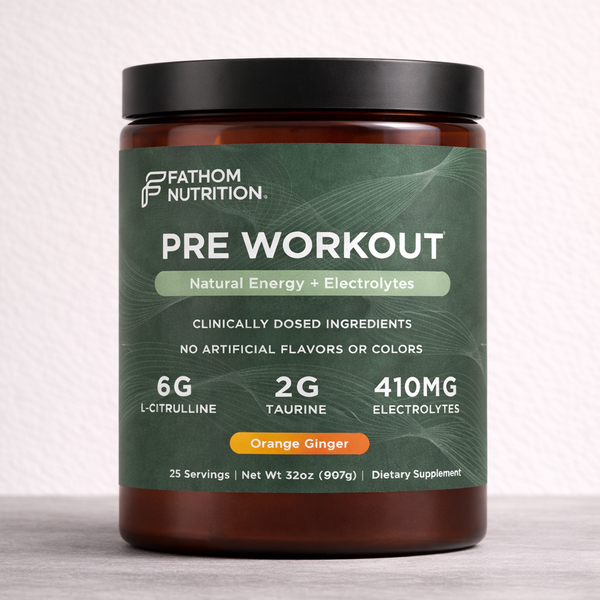
Pre Workout
Natural caffeine to make the race feel less hard. 3.2 g beta-alanine so every session contributes to carnosine loading. 6 g citrulline for better blood flow on the SkiErg and RowErg. L-tyrosine to keep your head in the game late in the race. Complete electrolyte matrix. Take 45–60 minutes before your hardest sessions and race morning. Every ingredient individually disclosed. No proprietary blends. Nothing artificial.
Bundle with Creatine → The Core Bundle, save 15%

Best Value
The Core Bundle
Creatine Monohydrate + Pre Workout. The two supplements every HYROX athlete needs from day one of their training block. NSF 455 certified. Full ingredient disclosure. Nothing artificial.
$129.98 $89.98 Save $40
Shop The Core Bundle →
Tier 3: Recovery and Durability Support
HYROX performance is built in training blocks over weeks, not on race morning. Tier 3 supplements don't move the needle on race day — they determine how well your body adapts to the training load, and how durable your joints and connective tissue stay across a high-frequency block that includes sled work, running volume, and repeated eccentric loading from lunges.
8. Omega-3 Fatty Acids (EPA + DHA)
Dose 2–4 g combined EPA + DHA/day
Timing Daily with food
Best for Athletes eating <2 servings fatty fish/week
At 2–4 g EPA and DHA daily, omega-3s reduce muscle damage and speed up inflammatory resolution for HYROX athletes training at high frequency. The effects are most pronounced in the 24–72 hours following sessions with significant eccentric loading — which describes every sim day with running volume and sandbag lunges. For athletes already eating two or more servings of fatty fish per week, supplementation adds less. For everyone else, this is one of the highest-return recovery investments at Tier 3.
9. Collagen Peptides + Vitamin C
Dose 10–15 g collagen + 50 mg vitamin C
Timing 45–60 min before a loading session
Frequency 3× per week on training days
HYROX is hard on connective tissue. The sled imposes significant knee and hip joint loading. Sandbag lunges generate high eccentric force through the quadriceps tendon. Cumulative running volume stresses the Achilles and plantar structures over a full training block. Shaw et al. (2017) documented significantly elevated collagen synthesis markers when 15 g of collagen peptides was consumed with 50 mg vitamin C approximately one hour before a loading session — the timing matters because collagen synthesis peaks during and after the session that follows. This is a long-game durability investment, not an acute performance tool. It pays off over months, and matters more for athletes over 35 where collagen synthesis is already declining. For a full breakdown of how supplement priorities shift after 35, see supplements for athletes over 35.
10. Vitamin D3
Dose 1,000–2,000 IU/day if insufficient
Test first Target serum 25(OH)D >30 ng/mL
Vitamin D insufficiency — serum 25(OH)D below 30 ng/mL — is associated with reduced muscle force production, impaired neuromuscular function, increased injury risk, and compromised immune function during heavy training blocks. Prevalence is high in indoor athletes and anyone in northern climates training year-round with limited sun exposure. The benefit is correcting insufficiency, not stacking vitamin D above normal ranges. Get tested before supplementing so you know whether you need it and at what dose.
Stack by Competitive Level
The appropriate stack scales with competitive level — not because the evidence for individual ingredients changes, but because higher competitive levels involve higher training volumes and tighter performance margins where Tier 2 and 3 benefits become more meaningful. Every level starts with the same Tier 1 foundation.
85–110 min
Entry Level
First Race
- Creatine 5 g/day
- Sodium electrolytes pre/post
- Caffeine on priority training days
- Vitamin D3 if insufficient
- Sleep + load management first
65–85 min
Competitive Open
Regular Competitor
- Full Tier 1 stack
- Beta-alanine 6+ weeks out
- Caffeine 3–5 mg/kg key sessions
- Nitrate race week + race day
- Carbs if race >75 min
- Omega-3 2–4 g/day
Sub-65 min
Age-Group
Serious Competitor
- Full Tier 1 + Tier 2 stack
- Caffeine tolerance management
- Pre-race plasma volume protocol
- Nitrate 3–5 day loading
- Collagen 3× per week
- Practiced intra-race carbs
Sub-60 min
Elite / Pro
Pro Category
- Full Tier 1 + 2 + 3
- Precision caffeine periodization
- Sweat-rate-calibrated sodium
- Blood glucose station windows
- Periodic bloodwork monitoring
- Sports dietitian oversight
- NSF 455 on every supplement
Age-Group Three-Product Stack
Creatine for station power. Pre Workout for session quality. Hydration for the training block and race morning sodium.
Creatine Monohydrate
5 g/day. ~20% more stored muscle energy. NSF 455 certified every batch. One ingredient.
Shop Creatine →
Pre Workout
Natural caffeine, 3.2 g beta-alanine, 6 g citrulline, L-tyrosine, HBCD, electrolytes. 45–60 min pre-session.
Shop Pre Workout →
Hydration
350 mg sodium, KSM-66 600 mg, Tart Cherry, magnesium bisglycinate. Pre-race, post-session, nightly. NSF 455 certified.
Shop Hydration →
Race-Day Timing Protocol
Race-day supplement timing is a protocol, not a collection of individual product decisions. Every element below should have been practiced during HYROX simulation sessions before race day. An untested protocol is a risk, not a strategy. Times shown assume a 9:00 am race start.
EVE
Night Before — 8–10 PM
Creatine 5 g with dinner · Omega-3 with dinner · 300–500 mg sodium in evening fluid
Maintain creatine saturation. Begin sodium pre-loading. Cut off caffeine by mid-afternoon to protect sleep quality — the most important night-before intervention.
5AM
Race Morning — 5–6 AM
Carb-rich breakfast: 80–120 g carbs, 20–25 g protein, low fiber/fat · Beta-alanine morning dose 2–3 g
Final glycogen loading. White rice, oats, banana, toast with honey. Avoid high-fat or high-fiber foods that slow gastric emptying. Blood glucose stability at race start.
−3H
2–3 Hours Pre-Race — 6 AM
Dietary nitrate: 5–8 mmol concentrated beet root shot
Needs time to convert to its active form. Avoid antibacterial mouthwash from this point through race finish — it kills the oral bacteria that do the conversion.
−90
60–90 Min Pre-Race — 7:30 AM
Hydration: 350 mg sodium in 400–500 ml water, sipped over 20–30 minutes
The most underused acute HYROX intervention. Sodium drives fluid into your bloodstream and keeps it there. Most athletes skip this. The ones who use it consistently notice the difference in stations 6, 7, and 8.
−60
45–60 Min Pre-Race — 8 AM
Pre Workout: caffeine 3–5 mg/kg + citrulline 6 g + beta-alanine 3.2 g
Timed so caffeine peaks at race start. If you did a caffeine reset this week, expect a stronger response. Use the exact product and dose practiced in training.
−15
15–20 Min Pre-Race — 8:45 AM · Optional
20–25 g fast carbohydrate gel or sports drink
Final blood glucose top-up for athletes with race time over 75 minutes only. Only if you've practiced this in simulation and confirmed no GI issues at race intensity.
RACE
During Race — 75+ min only
20–30 g carbohydrate between stations 3–5 · or one gel after station 4
Blood glucose maintenance for late-race output. Must be practiced in simulation. Start early — don't wait until you feel the deficit, which is too late.
POST
Within 30 Minutes of Finishing
Hydration in 500+ ml water · 40–60 g carbohydrate · 30–40 g complete protein
Sodium-containing fluid restores plasma volume significantly faster than plain water. Get protein in as soon as appetite allows. Non-negotiable if training again within 24–48 hours. For the full post-session nutrition framework, see the recovery nutrition guide for functional athletes.
Training Phase Periodization
Supplement needs shift across a HYROX training block. What matters 10 weeks out is different from what matters in race week.
| Training Phase | Supplement Priority Actions | Key Timing Notes |
|---|---|---|
| Base (weeks 1–4) | Begin creatine and beta-alanine at block start. Assess vitamin D. Begin omega-3. Use caffeine selectively on threshold runs only. | Starting now — not close to race — allows full saturation and carnosine loading before competition-intensity sessions begin. |
| Build (weeks 5–10) | Test nitrate timing 2–3 hrs before station-complex sessions. Introduce intra-session carbs during simulations above 60 min. Pre Workout on high-priority sessions only. | Collagen + vitamin C on the three highest-load training days each week for connective tissue durability. |
| Peak (weeks 11–14) | Every simulation runs the complete race-day protocol — same timing, same products, same doses. Resolve any GI issues or timing problems now. | Do not introduce any new supplement, product, or timing change in this phase. |
| Taper (weeks 15–16) | Maintain all chronic supplements. Reduce caffeine 7–10 days before target race to restore adenosine receptor sensitivity. | Caffeine reduction in taper is the intervention that maximizes race-day response. Do not skip it. |
Product Quality Standards
Full ingredient disclosure No proprietary blends NSF 455 certified Nothing artificial Verify registry before every race cycle
Three product quality criteria are non-negotiable for any serious HYROX athlete: full individual ingredient disclosure at verified amounts, named third-party certification with ongoing batch monitoring, and formulation without unnecessary artificial additives. Proprietary blends are the primary quality failure mode in sports supplements — a product listing active ingredients under a single total weight cannot be evaluated against clinical doses. This pattern is most prevalent in pre-workout formulas and electrolyte products — the two categories HYROX athletes use most.
For drug-tested HYROX categories, NSF 455 and NSF Certified for Sport are the certifications with defined banned substance screening scope and ongoing product monitoring. Verify current certification in the program's public product registry — not just from the label — before every competition preparation cycle. All Fathom Nutrition products are NSF 455 certified. Batch-level documentation is available on the third-party testing page.
What to Skip
BCAAs are the most expensive redundancy in HYROX stacks. An athlete consuming 1.6–2.2 g/kg/day from complete protein sources already delivers well above the leucine threshold for maximal muscle protein synthesis at each meal. Supplemental BCAAs add nothing to a saturated pathway. Any real value only exists in genuinely protein-restricted contexts — which doesn't describe most people training seriously for HYROX.
Glutamine supplementation rests on clinical evidence from critically ill patients, not healthy athletes. Training-induced immune suppression is better managed through load periodization, adequate sleep, and total energy availability than through glutamine supplementation.
Any proprietary blend product for active ingredients fails dose verification regardless of ingredient selection. If individual amounts are not disclosed, the product cannot be evaluated against clinical doses. This applies especially to pre-workout formulas claiming to contain clinical doses of citrulline, beta-alanine, or caffeine behind a "performance blend."
Fathom Nutrition — The Complete HYROX Stack
Every station. Every run. Every sim. NSF 455 certified. No proprietary blends.
Creatine Monohydrate
~20% more stored muscle energy. Station power output. Between-station recovery. 5 g/day. One ingredient. NSF 455 certified.
Shop Creatine →
Pre Workout
Clinical caffeine + 6 g citrulline + 3.2 g beta-alanine + L-tyrosine + electrolytes. Full Tier 1 + Tier 2 in one formula. Every dose disclosed.
Shop Pre Workout →
Hydration
350 mg sodium pre-race. KSM-66 600 mg for cortisol. Tart Cherry recovery. Magnesium for sleep. NSF 455 certified.
Shop Hydration →
FAQ
What is the single most important supplement for HYROX athletes?
Creatine monohydrate. It directly increases the stored muscle energy that powers every explosive station and determines how fast you recover between each station and the run that follows. No other single supplement addresses as many HYROX-specific limiters simultaneously — and the evidence behind it (ISSN Level A, hundreds of trials) is the strongest in sports nutrition.
When should I start taking beta-alanine before a HYROX race?
At least four weeks before race day — six to eight weeks is better. Beta-alanine produces no meaningful carnosine elevation in the first week or two of supplementation. Starting the week before a race gets you the tingling side effect and zero performance benefit. Begin at the start of your preparation block.
Does creatine affect running performance negatively in HYROX?
Not meaningfully in practice. The concern is the 1–2 kg of intramuscular water weight that comes with creatine saturation, but research in hybrid and endurance athletes has not demonstrated a meaningful negative effect on running performance at this level. The station performance gains and between-session recovery benefits substantially outweigh any marginal running cost. Start creatine at the beginning of your training block to adapt before race day.
Is caffeine effective if I drink coffee every day?
Daily habitual caffeine progressively reduces the acute ergogenic response as your body upregulates adenosine receptors to compensate. The fix: reduce caffeine significantly for 7–10 days before your target race to restore receptor sensitivity. On race day, the response will be noticeably stronger. Alternatively, keep habitual daily intake low and use performance doses selectively on key sessions and race day.
Do I need electrolytes during a HYROX race or just before and after?
The pre-race sodium loading protocol is the highest-priority intervention for most HYROX athletes. Intra-race delivery becomes relevant for athletes going above 75–80 minutes in warm indoor conditions. Post-race sodium-containing hydration is non-negotiable for athletes training again within 24–48 hours.
Are there banned substances I need to worry about in HYROX supplements?
HYROX Pro category events operate under anti-doping rules, and athletes carry strict liability — you're responsible for any prohibited substance regardless of source. The only meaningful consumer protection is NSF 455 or NSF Certified for Sport certification verified in the program's public product registry before every competition preparation cycle, not just once when you first purchase.
Should I use a pre-workout formula or take caffeine separately?
A fully disclosed pre-workout formula addresses multiple HYROX performance variables simultaneously from a single verified ingredient matrix — more practical than assembling five separate supplements before every session. The conditions: it must have no proprietary blends, be third-party certified, and be practiced at the exact dose and timing used on race day before you deploy it there.
What should I eat and supplement the night before HYROX?
A familiar carbohydrate-rich dinner with moderate protein and low fat and fiber. Creatine 5 g with dinner. Omega-3 with dinner. Begin light sodium loading with 300–500 mg spread across the evening fluid — not a single large bolus. Avoid caffeine after mid-afternoon. Sleep is the most important night-before performance intervention — don't compromise it trying to optimize anything else.
References
Kreider RB et al. ISSN position stand: creatine supplementation. J Int Soc Sports Nutr, 2017. Link
Guest NS et al. ISSN position stand: caffeine and exercise performance. J Int Soc Sports Nutr, 2021. Link
Trexler ET et al. ISSN position stand: beta-alanine. J Int Soc Sports Nutr, 2015. Link
Hobson RM et al. Beta-alanine supplementation meta-analysis. Amino Acids, 2012. Link
Jones AM. Dietary nitrate supplementation and exercise performance. Sports Med, 2014. Link
Shirreffs SM, Sawka MN. Fluid and electrolyte needs for training and competition. J Sports Sci, 2011. Link
Shaw G et al. Vitamin C-enriched gelatin supplementation augments collagen synthesis. Am J Clin Nutr, 2017. Link


